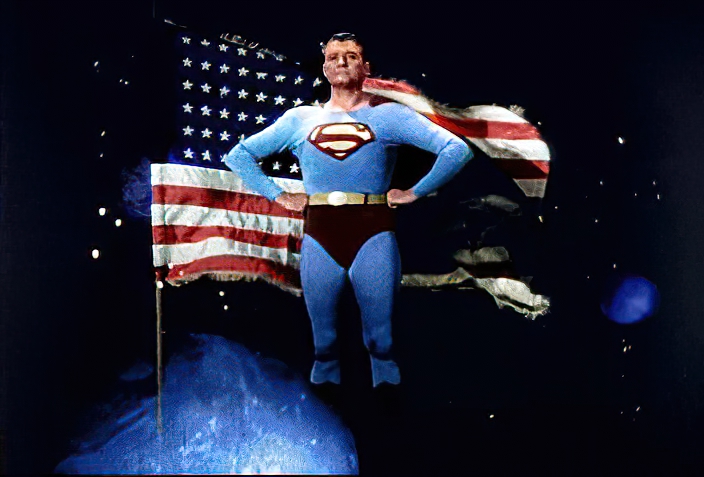
 Ask any Baby Boomer what comes after, “It’s a bird, it’s a plane…” and they will undoubtedly reply, “It’s Superman!”
Beginning in 1952, The Adventures of Superman aired weekly in virtually every market in America. That was quite an accomplishment as The Adventures of Superman never aired on any of the three major television networks in the 1950s. It was created purely for the syndication market, sold to individual stations. While there were other series to fall into this category, none of them ever achieved anything like the level of success Superman enjoyed. The show went through six seasons of new episodes, with production only ending in 1958 with the untimely death of its star, George Reeves, just as production was about to begin on season 7.
Superman continued on in reruns for many years after. It even got something like a second wind in the late 1960s. It seems the show’s producers had been extremely foresighted and began filming the episodes in color starting in the fall of 1955, a time when there were virtually no color television sets in any American home. Initially, producers simply ran off black & white film prints for distribution to the local stations. But by the middle of the 1960s, color television had become the norm, so they released new prints of roughly half of the Superman episodes, now being broadcast in full color for the first time. The show even enjoyed a run as part of the Nick at Nite line-up on cable’s Nickelodeon in the 1990s and is still seen from time to time on nostalgia networks like MeTV.
Of course, one of the reasons for its longevity is the continuing popularity and cultural relevance of the show’s main character. Superman has been the star of numerous feature films, countless animated series, and 4 additional live-action TV series since George Reeves first put on the cape (Superboy, Lois & Clark: The New Adventures of Superman, Smallville, and Clark & Lois).
The other reason is the unmistakable charm of its original cast: George Reeves, Jack Larson (Jimmy Olsen), Noel Neill (who succeeded Phylis Coates as Lois Lane after the first season, and Neil Hamilton (Perry White).
No matter how many times you may have watched the Man of Steel launch himself “up, up, and away,” we think there are several things you may not know about this legendary television series:
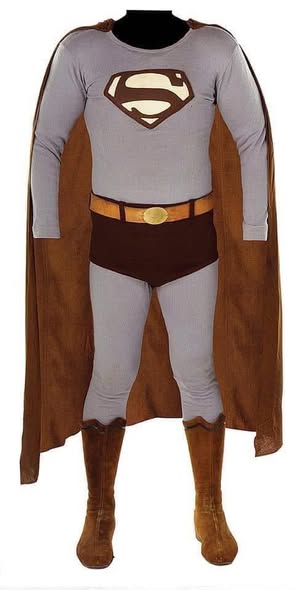 1.) The first Superman costume did not use the same colors as the comic books. During the first two seasons, which were shot in black & white, the costume was actually grey and reddish brown with jet black trunks. This is because they wanted to ensure that it looked right on all those black & white TV sets. When Superman switched to color, the costume was then recreated in the more familiar bright blue, red, and yellow.
2.) George Reeves was a heavy smoker. Go ahead and Google “George Reeves smoking.” You won’t find a single picture of him with a cigarette. This despite his having a serious tobacco habit in the early days of the show. That’s because Reeves took his job as an icon to American youth quite seriously (even more commendable when you know how much Reeves disliked playing Superman). He was scrupulous about never being photographed with a cigarette, even when out of uniform, because he didn’t want his youthful fans to get the idea that smoking was a good idea. In fact, Reeves eventually gave up smoking entirely.
3.) Jimmy Olsen underwent a significant change with the start of the TV series. The characters of both Perry White and Jimmy Olsen were created for the long-running Superman radio series, which was broadcast from 1940 through 1950. They moved over into the comic books shortly after their radio debuts. But on radio and in the comics, Jimmy had been a young kid, employed as a copy boy at The Daily Planet.
The low-budget nature of the Superman TV show required long, grueling hours in front of the cameras as they often attempted to shoot an entire season’s worth of episodes in just a few weeks. Hollywood labor laws wouldn’t have allowed a child actor to work those kinds of hours. So, the producers made Jimmy grow up into a young adult who was now a junior reporter on The Planet.
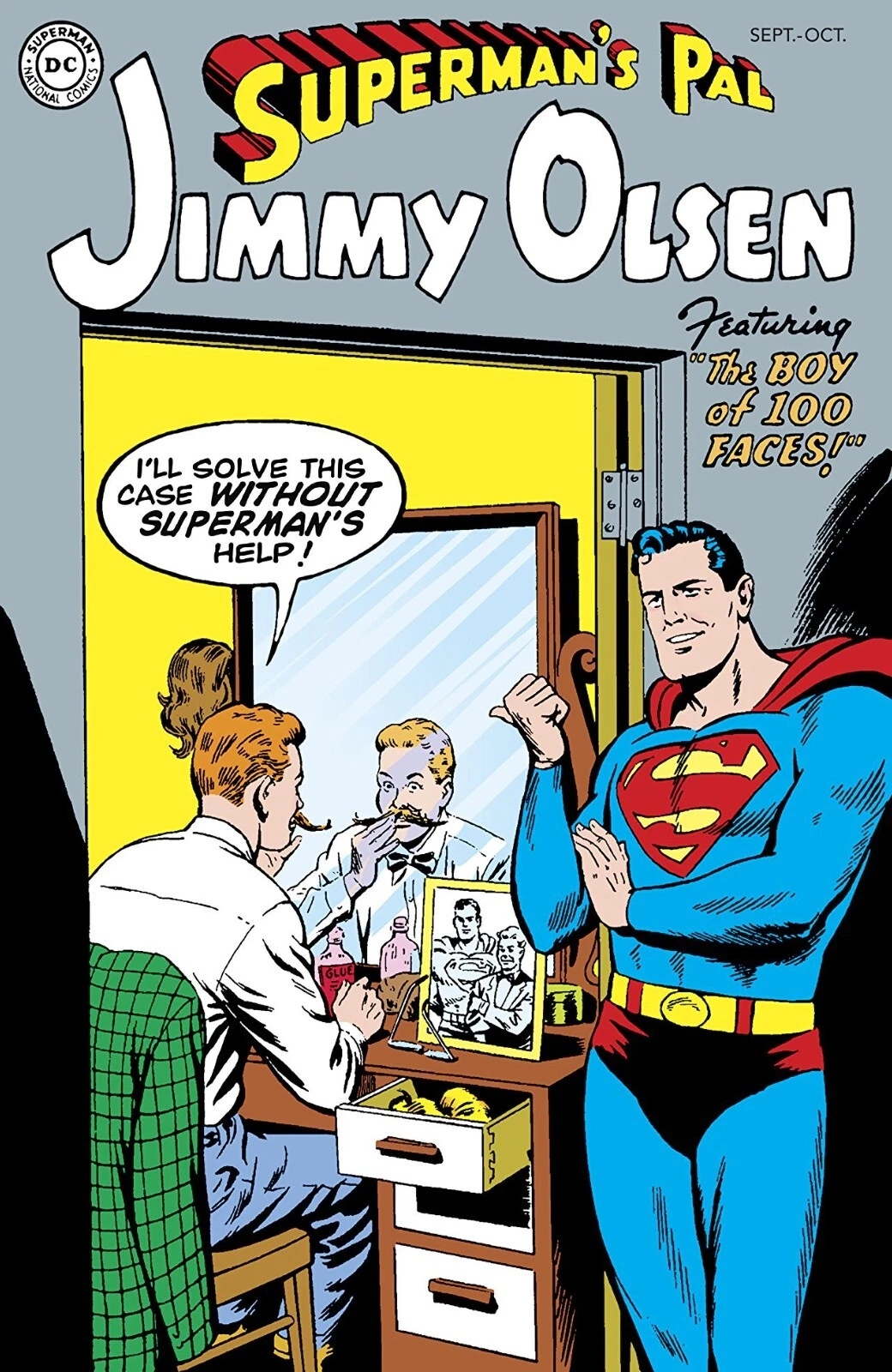
Larson’s portrayal was so popular with the show’s fans that Jimmy was not only aged up in the comics but also given his own comic book title in 1954, a first for a supporting character in the comic book world. Three years later, while the show was still in first run, Lois Lane also got her own comic book.
4.) They didn’t fly George Reeves using wires because of an early accident. Very early on in production, they attempted to fly George Reeves using wires, a common Hollywood practice for such scenes. You can see them in use in many of the first season episodes. However, during one such scene, the wires snapped and sent Reeves crashing to the ground. Luckily, he avoided serious injury, but he did receive multiple bruises. After that, the special effects team developed a metal harness that allowed Reeves to lie flat on it, almost like he was on a table. This harness could pivot a bit to simulate slight upward or downward movements and some banking effects, while a wind machine would give Reeves’ hair and cape a realistic flying look. Take-offs were handled by a springboard below camera range that allowed Reeves to launch himself over the camera. Fortunately, George was very athletic and could handle that kind of stunt work himself.
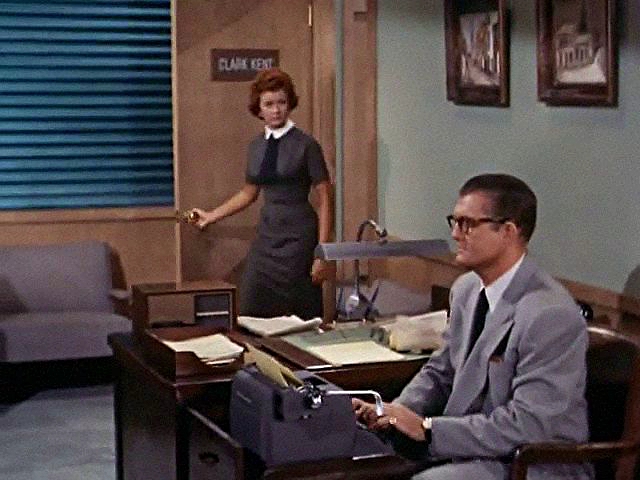
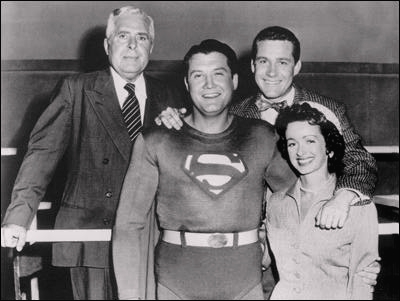 5.) Clark, Lois, Jimmy & Perry wore the exact same outfits in virtually every episode. As mentioned, Superman was produced on an extremely limited budget, much of which needed to go to the special effects necessary for Superman’s flights and super stunts. To save money and time, the cast was often required to shoot multiple episodes simultaneously. This was especially true of scenes shot on The Daily Planet sets. To avoid possible continuity issues of remembering what outfits each character was wearing in what episode, Clark, Lois, Jimmy, and Perry always wore the very same clothes from episode to episode.
In addition, there were only two office sets for The Daily Planet – Perry White’s and another set used for Clark’s, Lois’, or any other office the script called for. They just moved the desk to a different position, just the nameplate on the desk and door, and swapped out a few knick-knacks.
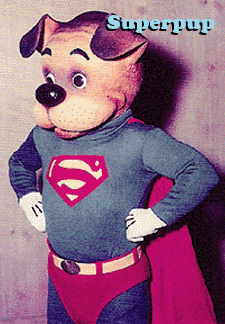
6.) There were three attempts to continue the never-ending battle after Reeves’ death. Superman had proved to be such a cash cow for the producers and DC Comics (then known as National Periodicals) that they explored three different ways to keep the gravy train running. The first was actually started before Reeves died, and it seems a bit crazy today. In 1958, while the original series was shooting what became its final season, producers proposed a second series where they reimagined all of the characters as canines. Yes, you read that correctly. A pilot for The Adventures of Superpup was shot in 1958. They used actors with dwarfism wearing dog masks. The familiar names were also changed to dog-friendly versions, like Bark Bent instead of Clark Kent and Terry Bite instead of Perry White. Mercifully, no one who saw the pilot wanted it to go to series.
After Reeves’ death, producers thought maybe they could simply continue the series, but focus on Jimmy Olsen as the lead character. The plan was to reuse footage of Reeves’ Superman that had been used in other episodes. Jack Larson, however, thought the idea was ghoulish and refused to continue that way.
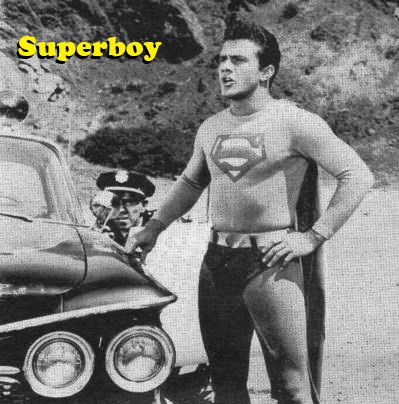
The producers' final idea was a show based on Superboy, Clark Kent as a youth. This wasn’t bad, as Superboy had been a legitimate character in the comics since 1944, dreamed up by original Superman co-creator Jerry Siegel. A pilot was shot in 1961, 3 years after Reeves’ death, starring Johnny Rockwell as the Boy of Steel and Bunny Henning as his girlfriend Lana Lang. They even went so far as to commission the creation of 12 completed scripts. But the pilot failed to attract any buyers. Too bad because Superboy would prove to be a very viable character, starring in multiple animated series and 4 seasons of a syndicated live-action TV series from the same team that produced the Christopher Reeve movies, and of course, 10 seasons of Smallville on the CW network – by far the most successful of any television series starring the Clark Kent character since George Reeves set the standard.